
What is a Public University?
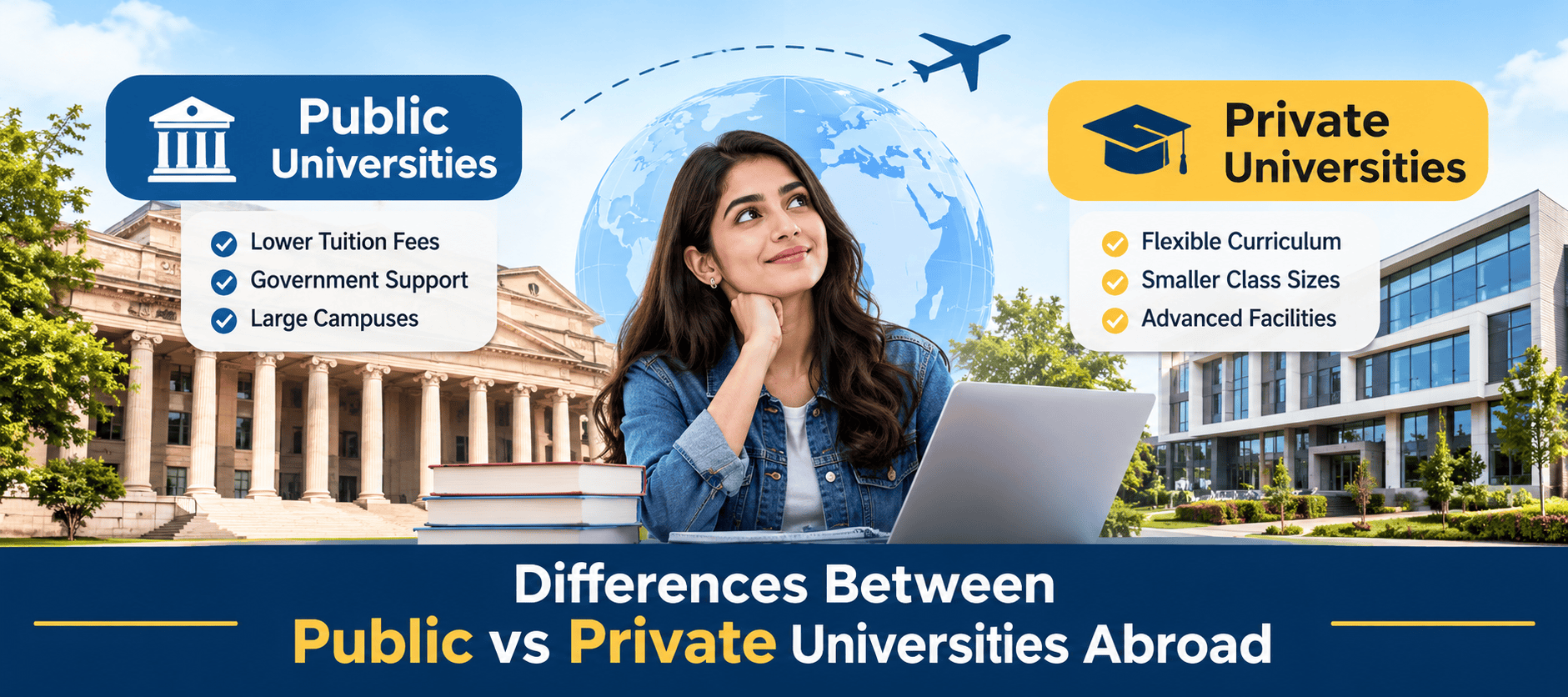
Public universities are government universities. These universities are funded and supported by the government of the country or state. The cost of studying at public universities abroad is relatively cheaper compared to private universities abroad. Thus, for higher education in the fields of management, STEM and humanities, students can choose public universities. There are also many benefits of public universities abroad. They have bigger campuses, a larger research scope and a high number of student enrollments.
Some of the popular public universities abroad are the University of Toronto in Canada, the University of Melbourne in Australia, the University of Texas, Purdue University, Oxford, Cambridge, and Russell Group institutions.
What is a Private University?
Private universities are funded through tuition fees, donations and private investments. They are not supported by the government. The cost of studying at private universities abroad is comparatively higher than at public universities. However, need-based and merit-based scholarships are provided, which can reduce the actual cost. Some of the benefits of private universities are flexible curricula and smaller class sizes with personalised attention. Some of the prestigious private universities abroad are Harvard, Stanford, MIT and others.
Public vs Private Universities for International Students: Key Differences
The main difference between public and private universities abroad is the tuition fees, course curricula, campus, classroom size and other facilities. The detailed distinction is given below.
- Tuition Fees and Overall Cost
Cost is one of the main aspects when it comes to studying abroad. This is one of the deciding factors in selecting the university. Public universities receive government subsidies and funding. Thus, as compared to private universities, public universities are cheaper and budget-friendly.
- Scholarships and Financial Aid
Though private universities are expensive, need-based scholarships and other financial aid can bring those costs to match your budget. These costs can even be lower than those of public universities. Ivy League universities in the USA are known for extending meaningful financial assistance for admitted students.
Scholarships are also offered by public universities. In such public institutions, the scholarship amount is however small and more competitive.
Indian students with a strong academic record must apply to both types of universities. They should select the university after they have compared both with the offered scholarships.
- Class Size With Personalised Attention
Private universities generally have smaller class sizes. They prefer low student-to-faculty ratios in order to provide personalised interaction with the mentors and professors. On the other hand, public universities have larger classrooms with a large number of students. One-on-one interaction is thus less than that of private universities. However, at the same time, students have access to more diverse student clubs and activities.
- Ranking and Reputation
When it comes to public vs private universities abroad, global rankings such as QS World University Rankings and Times Higher Education Rankings also become one of the major deciding factors. There are many public and private universities that have quite good rankings all over the world. Some of the top-ranking universities are Massachusetts Institute of Technology (MIT), USA, Imperial College London, UK, Stanford University, USA, University of Oxford, UK, University of Cambridge, UK and so on.
Indian students selecting between public and private universities should not compromise the reputation and ranking of the universities. This factor should not be ignored when considering career prospects.
- Research Opportunities
Government-backed public universities have larger research budgets. The public universities, being government-funded, also have strong industrial collaborations. This gives a major advantage for the students aiming to pursue a master's or PhD abroad.
- Campus Life and Student Diversity
The public universities abroad usually have a large diversity of domestic and international students. This offers students a bigger networking opportunity. Whereas private universities abroad have a smaller community but stronger alumni connections. These stronger alumni bonds provide networking and career support after graduation.
Which is better, public or private universities for international students?
There is no universal answer to which is better: public vs. private universities abroad. The answer to this question varies from person to person and their priorities.
If you are considering your budget and larger, research-funded universities with wide peer networks, then go with the public universities.
If you manage to get financial aid and prefer personalised interaction with the mentors and professors, then choose private universities.
Public Vs Private Universities Abroad: A Glance
Particulars | Public Universities Abroad | Private Universities Abroad |
Tuition fees | Less | High |
Class size | Large | Small |
Ease of admission | Competitive | Less competitive |
Diversity | More diverse | Less diverse |
Scholarships and financial aid | Government scholarships available | Both government and private scholarships available |
Alumni networks | Large | Strong, especially at top universities |
Curriculum | Standardised | Flexible |
Conclusion
Choosing between public vs. private universities may be a tough task. When deciding between the two, don't consider only the cost factor. Also consider your academic goals and career aspirations before making a choice. Weigh your options carefully by considering factors such as scholarships, rankings, class diversity, research opportunities and class size. A well-planned university application process can also help you make informed decisions and choose the right institution for your future.
Key Takeaways
Public universities are better than private universities is a myth. Both types of universities are unique in their own way.
Private universities are not as expensive as they seem on paper. They offer financial aid in the form of scholarships to eligible students. Thus, they make the cost of studying worthwhile for international students.
Like public universities, some private universities are also part of projects from top companies and governments.
Frequently Asked Questions
1. Do private universities offer better placements?
Answer: It is not necessary. Whether the university offers better placement depends on the program of study and the industrial collaboration. It does not solely depend on whether it is a private or public university.
2. Which universities, public or private, offer more scholarships?
Answer: Private universities offer larger amounts of scholarships and financial aid to students. Whereas public universities offer smaller amounts to a large number of students.
3. Which is better for international students: a public or a private university?
Answer: There is no universal answer to this question. The right choice depends on one’s budget, class size preference, scholarships or financial aid needs and career goals.
4. What is the key difference between a public university and a private university?
Answer: Public universities are run by governments of the state or the country. They have larger class sizes, generally offer lower tuition fees and are competitive for admission. Private universities are not government-backed universities. They have smaller class sizes, generally higher tuition fees and are less competitive.
5. Do employers prefer public or private university graduates?
Answer: There is no universal employer preference. They aim to choose the right candidate based on the program type and the individual candidate’s profile.
6. Which country accepts more international students?
Answer: The USA accepts most of the international students. Other countries accepting international students in large numbers are the UK, Australia, France, Germany, Japan and Canada.
7. Are private universities worth the higher tuition fees?
Answer: The tuition fee for admission abroad depends entirely on the type of course, net cost after aid and career aspirations. It does not have to do with whether the university is a public or private university.