Increased Administrative Workload
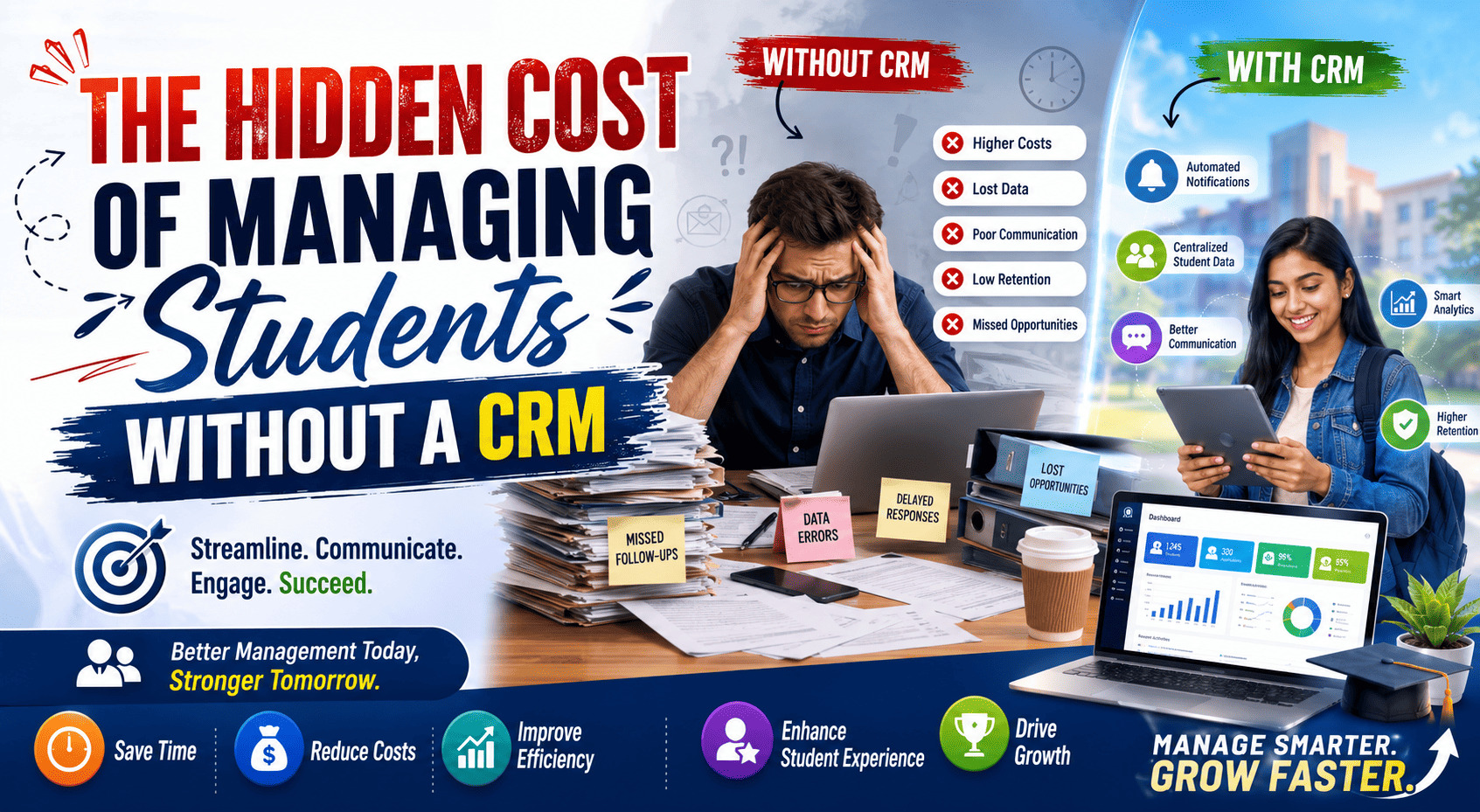
One major hidden cost of managing students without a CRM is the heavy administrative burden on staff. Administrative teams spend countless hours entering data, updating student records, searching for information, and replying to routine inquiries.
Without a centralized system, information often resides across various spreadsheets, files, and departments. Staff members must enter the same data multiple times into different systems, which raises the chance of errors and duplication. As student numbers increase, these manual tasks become more time-consuming and harder to manage.
This situation leads to decreased productivity, employee frustration, and rising operational costs. Staff have less time for activities that directly support student success and institutional growth.
Communication Gaps and Delays
Clear communication is vital in education. Students need prompt updates about admissions, classes, exams, fees, events, and academic progress. Without a CRM, communication often relies on manual emails, phone calls, or messaging apps.
This fragmented approach can cause missed messages, delayed replies, and inconsistent information. Students might overlook important deadlines, leading to confusion and dissatisfaction. Parents may also feel disconnected due to poor communication.
Ineffective communication can harm the institution’s reputation and negatively impact student engagement. A CRM helps automate notifications, reminders, and follow-ups, making sure that important information reaches the right people promptly.
Loss of Student Data and Information Errors
Handling student information manually raises the risk of data loss and inaccuracies. Paper documents can get lost, spreadsheets can become corrupted, and manually entered data can have errors.
Even small mistakes in student records can lead to big issues. Incorrect contact details may block important communications from reaching students. Mistakes in academic records can cause administrative problems and student complaints.
The time and resources needed to fix these issues add to hidden costs that often go unnoticed. A CRM keeps a centralized database where student information is stored securely and updated in real time, reducing the chances of errors and data loss.
Poor Student Experience
Today’s students expect a smooth and personalized experience. They want quick answers to questions, easy access to information, and effective support services. Institutions without a CRM often struggle to meet these expectations.
When students must repeatedly provide the same information or wait long for responses, their overall experience suffers. Unhappy students are less likely to recommend the institution and may even consider transferring to competitors.
Student satisfaction directly influences enrollment and retention rates, as well as the institution's reputation. A poor student experience can create significant hidden costs that impact long-term success.
Reduced Student Retention Rates
Student retention is a key performance indicator for educational institutions. Keeping current students is generally cheaper than attracting new ones. However, institutions without a CRM often find it hard to spot students who might drop out.
Without centralized data and tracking tools, monitoring attendance, academic performance, engagement, and communication history becomes difficult. Warning signs may go unnoticed until it’s too late.
A CRM allows institutions to identify at-risk students early and take proactive measures like counseling, academic support, and personalized communication. Without these tools, student dropout rates may rise, leading to lost revenue and lower institutional performance.
Inefficient Admission and Enrollment Processes
Admissions are often the first point of contact between students and educational institutions. A slow or disorganized admissions process can discourage potential students from completing their applications.
Without a CRM, admissions teams struggle to track inquiries, manage application statuses, and follow up with prospects. Important leads can be lost due to delayed responses or incomplete records.
Each lost applicant represents a missed revenue opportunity. Over time, such losses can significantly impact enrollment numbers and financial stability. A CRM streamlines admissions workflows, improves lead management, and boosts conversion rates.
Lack of Data-Driven Decision Making
Educational institutions generate vast amounts of data related to admissions, student performance, attendance, engagement, and finances. Without a CRM, gathering and analyzing this data is challenging.
Decision-makers often rely on incomplete information or manual reports that are tough to generate and understand. Because of this, strategic planning becomes less effective.
A CRM provides dashboards, analytics, and reporting tools to help institutions make informed decisions based on real-time data. Lacking such insights can result in missed opportunities, inefficient resource use, and slower growth.
Higher Operational Costs
Many institutions think avoiding CRM implementation saves money. However, the opposite is often true. Manual processes take more staff time, increase the likelihood of errors, and create inefficiencies in departments.
Tasks like record management, communication, reporting, and follow-ups consume resources that could be automated through a CRM. As student populations grow, operational costs increase correspondingly.
The hidden costs tied to manual management often surpass the investment needed for a CRM solution. Over time, a CRM can significantly cut operational costs while boosting efficiency and service quality.
Difficulty Scaling Operations
As educational institutions expand, managing larger student groups becomes increasingly complicated. Systems that work for a small student body often become inadequate as enrollment grows.
Without a CRM, institutions may encounter challenges with data management, communication, reporting, and student support. Growth may require hiring extra staff just to manage administrative tasks.
A CRM offers the scalability needed to support growth without a corresponding rise in administrative workload. This capability allows organizations to expand more efficiently and sustainably.
Competitive Disadvantage
The education sector is increasingly competitive. Institutions that embrace technology can offer better services, enhance student engagement, and operate more efficiently.
Organizations that continue to rely on manual processes may struggle to compete with those using modern CRM systems. Prospective students are more inclined to choose institutions that provide streamlined admissions, personalized communication, and responsive support.
Failing to adopt modern technology can lead to declining enrollment, reduced competitiveness, and slower growth.
Conclusion
Managing students without a CRM may seem manageable in the short term, but the hidden costs can quickly add up. From increased administrative workload and communication gaps to data inaccuracies, lower retention rates, and higher operational expenses, manual processes can limit an institution’s ability to grow and deliver exceptional student experiences.
As educational institutions face increasing competition and rising student expectations, investing in the right technology is no longer optional—it is essential. A dedicated education CRM helps streamline operations, centralize student data, improve communication, and support data-driven decision-making. Solutions like EduCtrl CRM empower institutions to reduce inefficiencies, enhance student engagement, and build a scalable foundation for long-term success. By adopting a CRM, educational organizations can focus less on administrative challenges and more on what matters most: helping students achieve their goals.